

UNH 2Q26: The Rebuild Passed Its First Real Test
Even after removing all $860 million of favorable medical development, adjusted EPS was approximately $5.61. Medicare and Optum Health raised the base; commercial trend above 11% is the key caveat.
Bottom line. UNH’s second quarter materially exceeded the clean-beat threshold. Adjusted EPS of $6.38 was 30% above the $4.91 FactSet consensus and 28% above the $5.00 Graver Research estimate; the 86.7% medical care ratio was 180 basis points favorable to StreetAccount consensus. The $860 million of net favorable medical development requires scrutiny, but does not explain the result. Removing the entire amount raises MCR to approximately 87.7% and reduces adjusted EPS to roughly $5.61—still 85 basis points and 14% favorable to consensus, respectively.
The quarter establishes a higher and more credible earnings base. UnitedHealthcare and Optum Health produced roughly 83% of the $1.75 billion consolidated adjusted operating-earnings upside, and both full-year segment guides moved higher. The offset is commercial cost trend modestly above 11%, which extends full commercial margin recovery beyond 2027. Medicare improved materially, but management did not characterize that performance as a broad utilization inflection.
Exhibit 1. 2Q26 at a glance
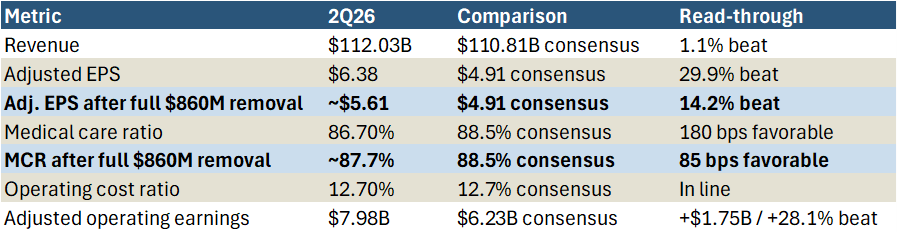
The beat survives the harshest reserve adjustment
The full-removal case is intentionally severe. Management said most of the $860 million related to 2026 dates of service, so treating it as a stale prior-year reserve release would be too punitive. The calculation nevertheless provides a useful earnings-quality bookend: it adds the full amount back to reported medical costs and removes the after-tax EPS impact using the updated 18.5% tax rate and 906 million diluted shares.
The operating upside was also broad enough to survive that adjustment. UnitedHealthcare and Optum Health contributed $822 million and $636 million of variance versus Street expectations, respectively. Optum Insight added $213 million and Optum Rx $100 million. Revenue was only 1.1% above consensus and the 12.7% operating cost ratio was in line, making margin execution—not top-line leverage—the principal source of upside.
Exhibit 2. The 2Q26 Beat Survives a Full Medical Development Normalization
The full-removal case remains favorable to both Street and Graver Research expectations; UnitedHealthcare and Optum Health account for most of the operating-earnings variance
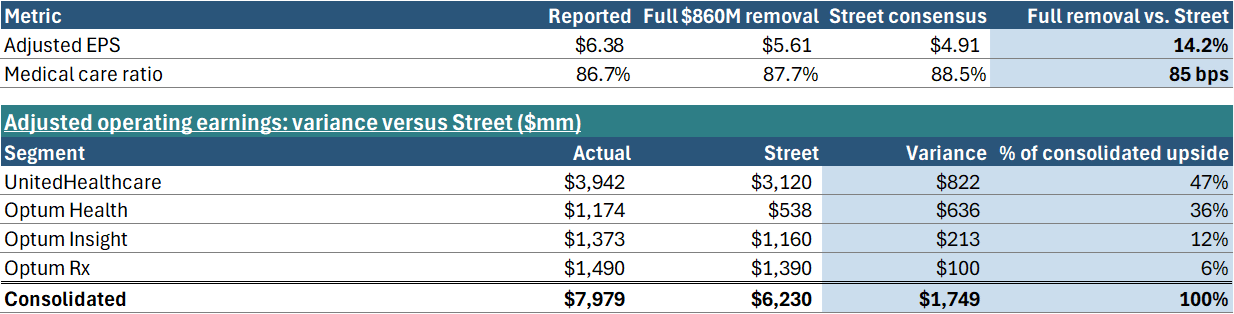
Medicare improved enough to offset a worse commercial trend
UnitedHealthcare was the largest source of upside, with $3.94 billion of operating earnings versus $3.12 billion expected. The full-year floor increased to $12.0 billion from $10.8 billion. Medicare cost trend is now expected below the initial approximately 10% plan, retention was better than anticipated, and management expects Medicare Advantage enrollment to decline by roughly 1.1 million while margins finish above 3%. Benefit design, care management and network actions drove much of the improvement, although respiratory season, weather and favorable development also helped. Medical trend remains well above historical levels.
Commercial moved in the opposite direction. Cost trend is now modestly above 11%, with the No Surprises Act dispute-resolution process contributing roughly 50 basis points of incremental 2026 trend and at least 100 basis points in total. Higher coding intensity, cost per encounter and specialty-drug pressure are additional drivers. Management now expects full commercial margin recovery after 2027. Medicaid performance was broadly in line, with the 2026 margin outlook unchanged at negative 1.0% to negative 1.7%. The UnitedHealthcare guide raise is therefore Medicare-led; commercial remains the largest insurance-side uncertainty.
Optum Health was the second real positive; Insight included timing
Optum Health generated $1.174 billion of adjusted operating earnings versus $538 million of Street consensus and the $509 million Graver Research estimate. Its adjusted full-year floor increased to $2.215 billion from $1.577 billion. Clinical and operating improvements appear tangible—management cited an approximately 10% reduction in inpatient admissions from one scaled care-management initiative—but the quarter should not be annualized. Nearly all Optum Health earnings are expected in the first half, with a modest third-quarter profit offset by a modest fourth-quarter loss.
Optum Insight also beat, with $1.373 billion of adjusted operating earnings versus $1.160 billion expected, but some client transaction volume moved from the second half into the first. Its $4.75 billion adjusted full-year floor is unchanged. Optum Rx produced $1.490 billion versus $1.390 billion expected and retained its $6.25 billion guide. Both businesses remain approximately 55% second-half weighted. The formal 2026 reset is therefore concentrated where the operating evidence was strongest: UnitedHealthcare and Optum Health.
Exhibit 3. The 2026 Guidance Reset Is Concentrated in UHC and Optum Health
The adjusted segment operating-earnings floor increased by approximately $1.84 billion, entirely from UnitedHealthcare and Optum Health. First-half adjusted EPS of $13.61 implies a second-half midpoint of only $6.14.
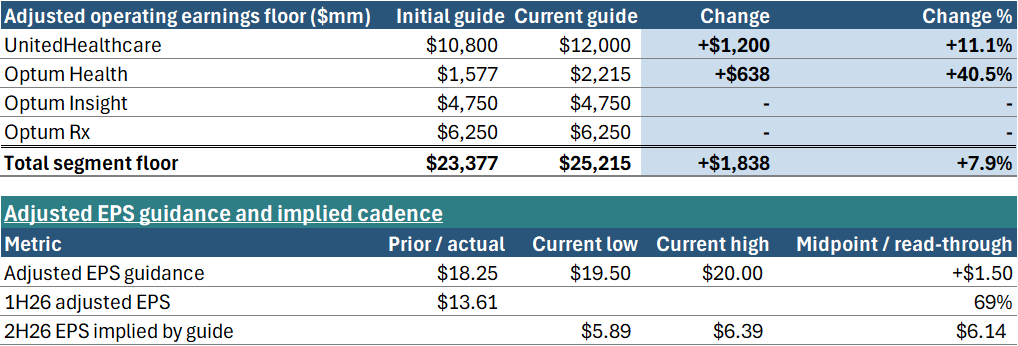
A higher base, not a higher second-half run rate
Updated adjusted EPS guidance of $19.50 to $20.00 is well above the prior floor of $18.25, but the cadence remains back-end light. First-half adjusted EPS of $13.61 leaves $5.89 to $6.39 for the second half, or $6.14 at the midpoint. Management expects slightly more earnings in the third quarter than the fourth; UnitedHealthcare remains roughly 75% first-half weighted and Optum Health nearly entirely first-half weighted, while Insight and Rx provide the second-half offset.
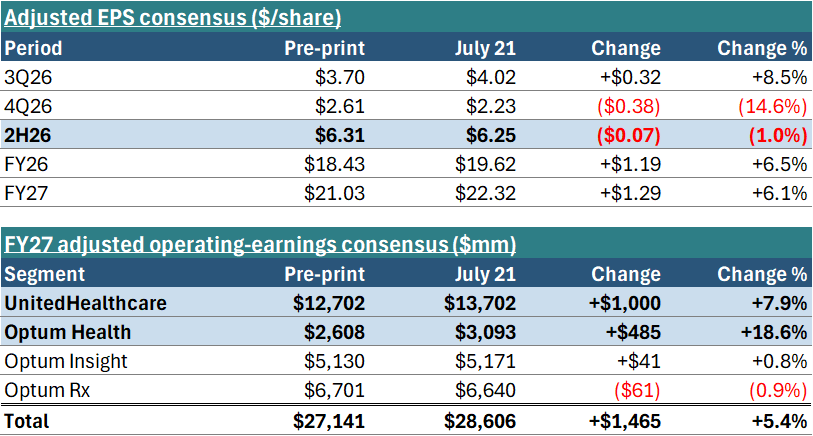
The refreshed Bloomberg cadence confirms that the Street has not extrapolated the 2Q beat into a higher second-half run rate. Third-quarter EPS consensus increased to $4.02 from $3.70, while fourth quarter declined to $2.23 from $2.61; aggregate second-half EPS is essentially unchanged at $6.25 versus $6.31 pre-print. FY26 and FY27 consensus increased 6.5% and 6.1%, respectively. The FY27 segment revision is concentrated in UnitedHealthcare and Optum Health, which increased by approximately $1.00 billion and $485 million; Insight rose only $41 million and Rx declined $61 million.
Management described the $19.50 to $20.00 range as a durable stepping-off point for its 13% to 16% long-term growth algorithm, while acknowledging that the range includes favorable medical development. Current FY27 consensus of $22.32 represents 13.0% growth from the 2026 midpoint—effectively the low end of that framework. The estimate reset is credible, but delivery still depends primarily on insurance execution and Optum Health rather than a near-term acceleration in Insight or Rx.
Exhibit 4. Consensus Carries the Reset into 2027, Not into 2H26
Post-print consensus shifts earnings from 4Q into 3Q but leaves aggregate second-half EPS essentially unchanged. The FY27 operating-earnings revision is concentrated in UnitedHealthcare and Optum Health.
The market raised the earnings base without expanding the multiple
UNH entered the print with a demanding setup: shares rose 21.0% from April 21 through the July 15 pre-print close, versus 7.2% for the S&P 500 and 8.5% for XLV. Through July 21, the stock gained 4.3% while FY27 EPS consensus increased 6.1%, reducing the implied FY27 P/E from 19.9x to 19.5x. The earnings reset outpaced the stock; commercial trend and reserve quality prevented multiple expansion.
Reserve quality is supportive, but the 10-Q still matters
Release-level balance-sheet indicators lean supportive: medical costs payable increased 1.3% year over year while premium revenue declined 1.1%, and days claims payable of 47.0 was 2.5 days above 2Q25. DCP declined sequentially, which management attributed to normal seasonality. Without the incurred-period roll-forward, the reserve cushion cannot be fully reassessed until the 10-Q is filed.
Investment conclusion. The 2Q print confirms that the rebuild can produce cleaner earnings and a higher baseline, supported by real improvement in Medicare and Optum Health. It does not establish a broad medical-cost inflection. Further re-rating likely requires commercial pricing to catch up to trend, Medicare margins to survive the 2027 bid cycle, Optum Health to hold through the weaker second half, and the 10-Q reserve roll-forward to support the release-level indicators.